





Years of bending, lifting, turning, twisting can leave a mark on the neck, taking into account all the stress that recurs from day to day, it is not surprising that about two thirds of people feel neck pain at some point in their lives. Cervical syndrome is much more than just neck pain. Degenerative processes can cause radiating pain, numbness and weakness in the shoulders, arms and hands. Cervical syndrome includes a group of symptoms and signs that occur due to compression and irritation of the spinal roots and blood vessels in the neck and lead to sensitive, motor vascular disorders.
CAUSE
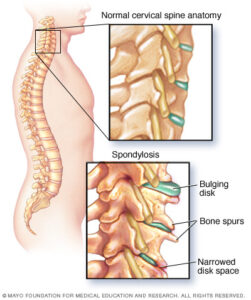
 The main role in the development of cervical syndrome is played by degenerative changes, which first appear on the intervertebral discs, leading to a gradual narrowing of the intervertrebral space, and osteophytes are formed at the edges of the vertebrae. In people with degeneratively altered bone and joint structures of the cervical spine, even the slightest trauma, sudden head movements, unfavorable position of the head during sleep or some professional activities can lead to displacement of the cervical vertebrae from their normal position and thus cause irritation and compression of nerve roots. . The narrow cervical syndrome can be osteoporosis, ankylosing spondylitis, rheumatoid arthritis, disc herniation, disc degeneration, dehydrated discs: the discs act as pads between the vertebrae of the spine. By age 40, most people’s spinal discs begin to dry out and shrink, allowing for greater bone-to-bone contact between the vertebrae.
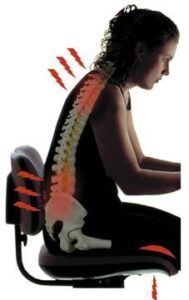
In today’s civilized society, the sitting position is represented during the work process in most employees. Sitting especially at the computer and poor position of the shoulder-neck region in a static position leads to muscle tension and poorer blood flow. or at school contribute to increased strain on the cervical spine, as well as poor night rest on a pillow that is too high or too low and sleep on the stomach.
All this leads to the loading of the disc structures and the occurrence of degenerative changes on the disc and bone structures.
CLINICAL PICTURE
The clinical picture of cervical syndrome can be divided into several separate forms:
The most common signs are:
TREATMENT
In the acute phase , when the pain is intense and the cervical spine is stiff, the goal of treatment is to reduce pain and relieve muscle spasm, ie to break the vicious circle of pain. – spasm – pain. It is necessary to provide immobilization and relief of the cervical spine with a special orthosis (trench collar) which reduces pain and muscle spasm. Drug therapy in the form of analgesics, muscle relaxants, antirheumatics is also taken. When the symptoms subside, the disease enters the subacute phase.
In the subacute phase, physical therapy is applied, in the form of electrotherapy , magnetotherapy ( Salus-Talent / strong>), ultrasound therapies , kinesitheping and kinesitherapy , with the aim of improving the nutrition of the neck region, strengthening muscles, and thus relieving all neck structures as well as relieving discomfort. In this phase, the mobilization of the neck can be done, whereby the joint structures, more precisely the facet joints, the cervical spine are repositioned and instantly cause relief in movements, and even relief of symptoms of tingling and pain along the arm and shoulder. .
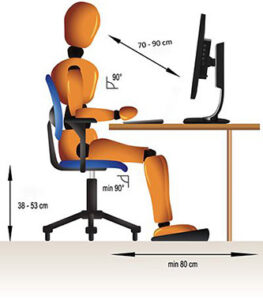
In the chronic phase, the range of exercises increases, which further improves the functionality and mobility of the neck, strengthens the muscles while relieving symptoms. You can do mobilization and manipulation of the joints of the cervical spine, which, along with the kinesitherapy program, bring excellent results in the long run. It is recommended to keep sitting in the correct position for people who are engaged in office work or work in which they sit a lot.
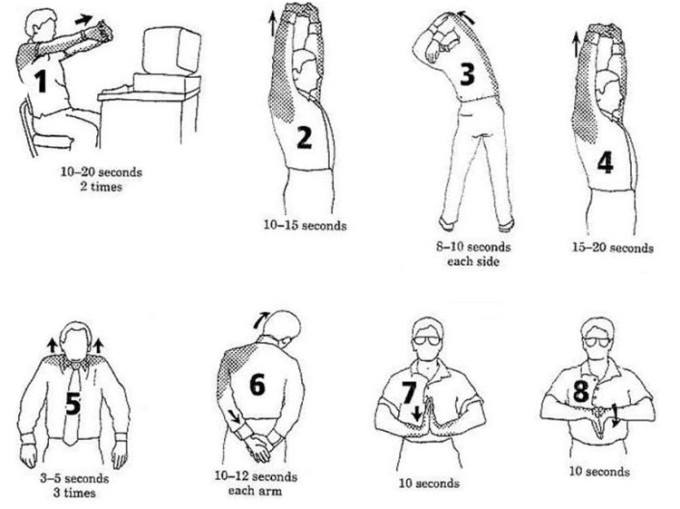
People who sit for a long time are advised to take short breaks of 10 minutes, every 3 hours and do a couple of very simple exercises, such as raising the arms above the head and stretching. It is important to emphasize that the exercises are done with open eyes, lightly and do not provoke pain.
LET YOUR CHOICE FOR SOLVING THE PROBLEM BE WITH US! ACCURATE DIAGNOSIS AND EFFECTIVE THERAPY ARE THE ONLY WAY TO SOLVING THE PROBLEM, THE WAY WE ARE GUIDED TO. WE USE MODERN METHODS OF PHYSICAL THERAPY, MODERN APPARATUS LIKE SALUS-TALENT, INDIBA-ACTIVE CELL AND WE HAVE EXPERIENCED AND EDUCATED PHYSIOTHERAPISTS WHO WILL CHOOSE THE RIGHT KINESIGA THERAPY. WE ALSO HAVE VARIOUS ORTHOTIC ASSISTANTS, IN THIS CASE THE Trench Collar, AS WELL AS THE PHILADELPHIA COLLAR.
SALUS-TALENT https://www.fizioaktiv.co.rs/salus-talent-pro/
Electromagnet of high magnetic induction which has an excellent analgesic effect on the joints, dispersion effect on the swelling, so it proved to be extremely effective in spinal pain problems such as spondylosis, dysarthrosis, lumbago, lumbosciatica, cervical syndrome, … This magnet is the first an electromagnet that is individually dosed according to the patient’s feeling, so that unlike standard magnets, the patient can feel from mild vibrations to very strong muscle contractions with therapy on this magnet. The analgesic effect, ie the effect of reducing pain, is felt very quickly, sometimes even after the first treatment.
INDIBA-ACTIVE CELL https://www.fizioaktiv.co.rs/indiba-proionik-sistem/
This is an extremely pleasant therapy for the patient. It is done in the form of a massage while the free electrode is in the therapist’s hand. It has the best effect on soft tissues such as muscles, tendons, ligaments, … It has shown itself perfectly in reducing muscle spasm, ie. muscle relaxation, elimination of swelling, and has the fastest analgesic effect so that the pain stops during the first treatment. In cervical syndrome, it is most often used as an introductory procedure.